I just retired about a year ago. As part of an annual review, I’m taking a fresh look at the retirement plan and considering the validity of its projections and where they might need to be adjusted. Our retirement plan is impacted quite a lot by social security benefits. The reality is that those benefits are scheduled to be paid in the future, and there’s some risk that the payments won’t be as large as promised in social security income statements.
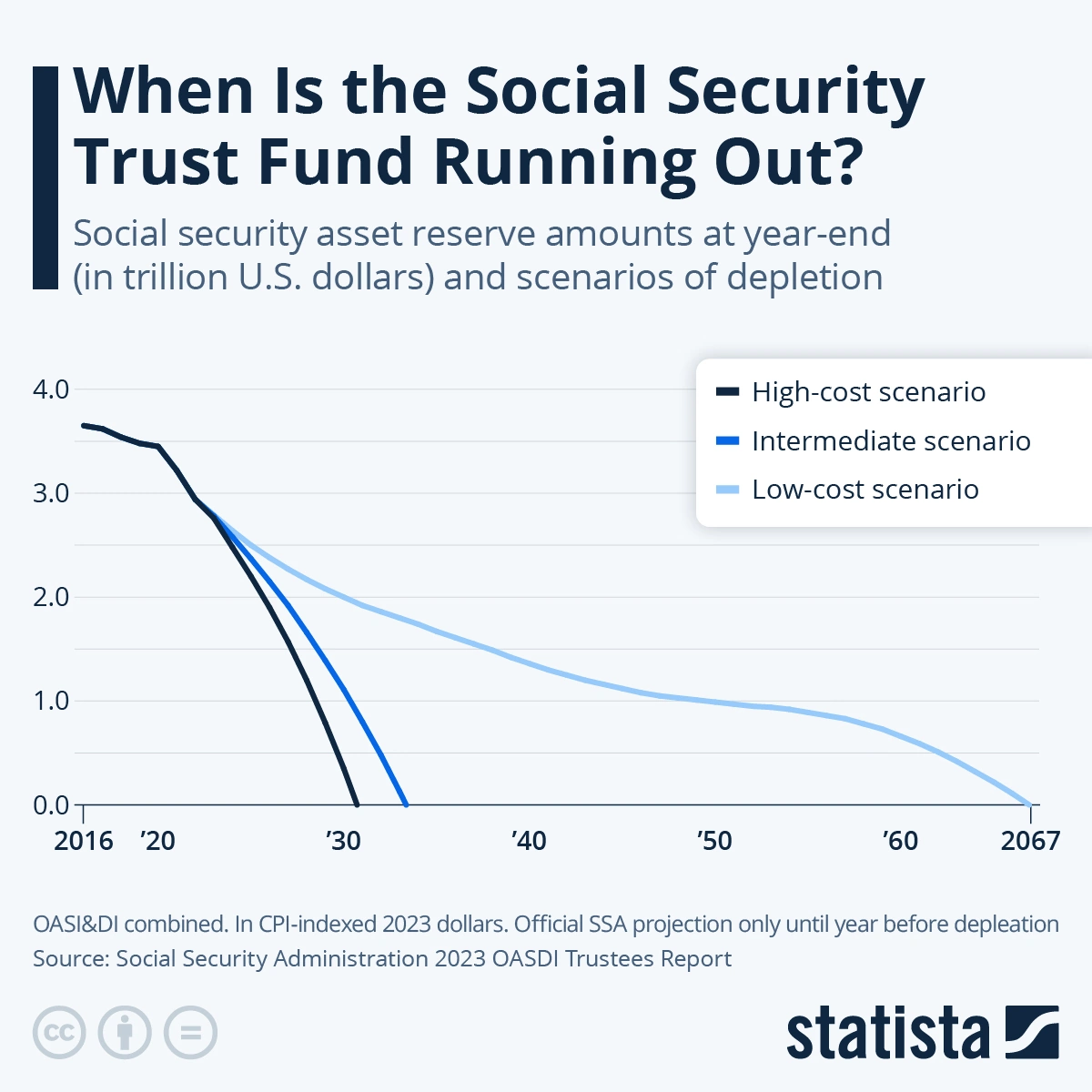
The projected income shown in the annual Your Social Security Statement assumes that the money being promised will also be available to be paid from the balance of the Social Security Trust Fund. Problem is, it looks clear that there will be challenges maintaining the balance in that fund in the coming years.
The main drivers affecting social security during our planned retirement years are:
- Boomers retiring + longer lifespans. Results in more people collecting benefits for more years.
- Lower birth rates in the post-boomer decades. Results in fewer payroll-tax payers supporting the retired population.
The Social Security Administration releases occasional projections of the trust fund balance. Based on the 2024 Social Security and Medicare Boards of Trustees Statement, the retirement fund (OASI) will run out of money in 2033 (the combined trust funds – OASDI lasts till 2034). Once the fund is exhausted, benefit payments become limited to current payroll taxes, which are projected to be 79% of scheduled benefits. Even more significant cuts are on the table in subsequent years without action.
What’s the trend on trust fund projections? Well, the 2033 exhaustion moves the year from a previous prediction of 2036 made in 2021. That sounds alarming. But this at least doesn’t appear to be something that will continue. There was lower-than-expected payroll tax revenue post-COVID, and labor force partipation didn’t rebound quickly, and many people retired early. There were also higher COLAs with the sudden spike in inflation (which rachets up benefits permanently). Finally there was also a decrease in life expectancy post-COVID and that shaped forecasts, but the real effect has been temporary so people are actually collecting benefits for longer.
So are cuts of the magnitude indicated by trust fund balances invevitable? No. That’s what will happen with no action by congress. Will congress act? Yes. It’s virtually inevitable. Allowing cuts of this size to current and near-term retiree benefits will be unthinkable politically. Will congress eliminate the cuts altogether? No. The funding challenge and its impact to the rest of the population is what they’ll be up against, and it’s big.
So what might congress do other than cut benefits?
- Increase payroll taxes, currently at 12.4% (6.2 employee, 6.2 employer). A 1% increase (0.5 on each side) would bring in a lot of money. The longer this doesn’t happen, the more dramatic the fix needs to be as opposed to taxes phased in over several years.
- Raise or eliminate the taxable wage cap. Right now contributions cap at a $176K income level. Congress might change this by raising that cap, or by reapplying FICA to earnings above $400K (i.e. the “donut hole”) such as that proposed in the Social Security 2100 Act.
- Tax certain non-wage income. Taxes might close self-employment loopholes, tax some fringe benefits, or possibly investment income (politically difficult).
- Raise full retirement age.
- Other, including modify wage indexing, reduce COLA, means testing.
Most likely, what’s done will be a combination of these things, and only a partial job of restoring 100% of benefits. Each of these actions will see political push-back from large numbers of affected individuals. How all that shakes out is uncertain.
To think there will be no cuts appears to be an unwise stragegy.
How big will the cuts be?
That’s the million dollar question. Who knows? Predicting nothing doesn’t make sense. Predicting the full default cuts (at least for current/near-term retirees) is probably overly conservative.
In the table below, the default cuts reflect what current law requires if Congress does nothing. Once the trust fund is depleted around 2033, benefits must be limited to annual payroll tax, producing an immediate cut of roughly 20% that slowly worsens over time as demographic trends continue (these figures are less certain than the trust fund projection but are heading in the right direction). This path assumes zero political intervention, no additional revenue, and no changes to benefit formulas. Cuts on this scale have never occurred when a large, well-understood cliff was visible years in advance.
The predicted cuts, assume Congress behaves as it historically has: acting late but not allowing an abrupt, permanent reduction of the default magnitude for current and near-term retirees. In practice this usually means a combination of measures – raising the taxable wage cap, modest payroll tax increases, and slowing benefit growth for higher earners and future retirees. That should partially restore solvency, but may well not fully return benefits to 100% of scheduled levels. The result is a smaller, temporary shortfall around the depletion date that gradually stabilizes at a lower but politically tolerable level.
| Year | Default cut (do nothing) | Predicted cut (likely action) |
|---|---|---|
| 2030 | 0% | 0% |
| 2031 | 0% | 0% |
| 2032 | 0% | 0% |
| 2033 | -20% | -15% |
| 2034 | -20% | -14% |
| 2035 | -21% | -13% |
| 2036 | -21% | -12% |
| 2037 | -22% | -11% |
| 2038 | -22% | -10% |
| 2040 | -22% | -10% |
| 2045 | -24% | -10% |
| 2050 | -25% | -10% |
| 2054 | -26% | -10% |
To simplify planning it might make sense to assume a permanent cut of about 12% in 2033.
I’m just an individual sharing my thoughts and analysis, not a financial professional. Do your own research or consult a qualified advisor before making financial decisions.